

Experts say that regulation is needed to guide responsible and ethical development within the revolutionary science of bio-hybrid robotics, which combines artificial components along with living tissue and cells.
In a paper published in the Proceedings at the National Academy of Sciences, a multidisciplinary team from the University of Southampton and universities in the US and Spain set out the unique ethical issues this technology presents and the need for proper governance.
The fact that this field of investigation has combined living material and organisms, from the very simple to the complex, with synthetic robotic components in a manner which at the moment is no science fiction—well, this developing field just keeps on getting better. Biohybrid robots with living muscles can crawl, swim, grip, pump, and sense surroundings. Sensors fashioned with sensory cells or insect antennae improve chemical sensing. Living neurons have even been used to control mobile robots.
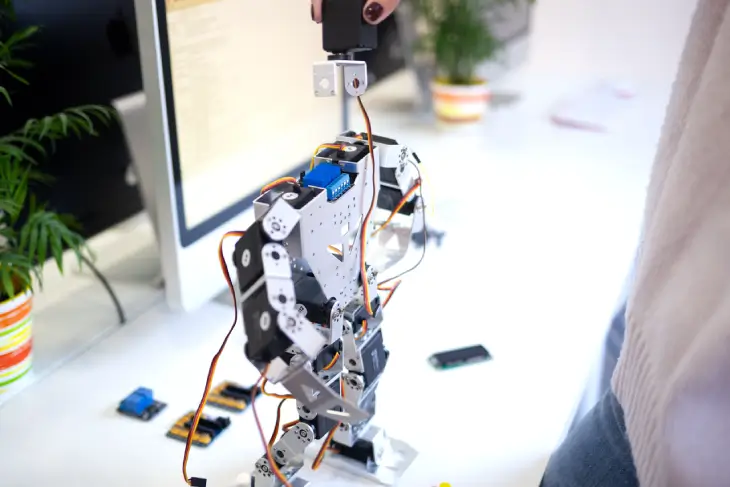
Image Source: Envato
Dr. Rafael Mestre of the University of Southampton, who led the research and is an expert in emergent technologies, said: “The challenges that come into play when it comes to regulating bio-hybrid robotics are really not very different from what we get with biomedical devices or stem cells, for example—other disruptive technologies. But while purely mechanical or digital technologies have clear family forebears and precedents to fall back on and draw from, biohybrid robots blend biological and synthetic components in quite unprecedented ways. This places unique possible benefits but also potential dangers.”
Publications in biohybrid robots have also been relentlessly rising for the past ten years. Still, according to existing authors, despite the existence of over 1,500 publications in this field at the time, only five publications had focused on deeper ethical implications.
The paper’s authors discern three areas in which bio-hybrid robotics raises new ethical issues: Interactivity — how bio-robots interact with humans, and the environment. Integrability — how and whether humans might fit or assimilate bio-robots into their bodies—for example, by having a bio-robotic organ or limb. Moral status.
They use thought experiments to make such cases that bio-robots cleaning our oceans destroy the very food chain, raise inequalities through a bio-hybrid robotic arm, and evermore sophisticated ‘assistants’ with questions of sentience and moral value.
“Bio-hybrid robots establish unique ethical dilemmas,” says Aníbal M. Astobiza, an ethicist from the University of the Basque Country, in Spain, and co-lead author of the paper. “Namely, they regard living tissue used in their fabrication, with a potential for sentience, a different environmental impact, unusual moral status, and capacity of biological evolution or adaptation that create unique ethical dilemmas that go beyond those of totally artificial or biological technologies.”
The paper is the first major output from the Biohybrid Futures project led by Dr Rafael Mestre in close collaboration with the Rebooting Democracy project. It also contributes towards the wider goal of Biohybrid Futures: to develop a framework for responsible research, application and governance of bio-hybrid robotics.
It also puts forward some requirements that it believes the framework should entail, such as risk assessments, consideration of social implications, and raising public awareness and understanding.
Referring to emergent technology’s moral dilemmas, Jr. Matt Ryan of the University of Southampton says: this political scientist and co-author on the paper, “If debates around embryonic stem cells, human cloning, or artificial intelligence have taught us something, it is that humans rarely agree on the correct resolution.”
Compared with related technologies—to embryonic stem cells or artificial intelligence—the development of biohybrid robotics has relatively been free of media, public, and policy-makers’ attention, though of no lesser importance. We want that the public be involved in this discussion to guarantee a democratic approach towards the development and ethical evaluation of this technology. Moreover, the authors have singled out certain actions that the research community should undertake immediately to lead the research into the much-needed governance framework.
“The steps should in no way be viewed as prescriptive, but rather as sharing the responsibility, removing a heavy weight from the researcher’s shoulders,” says co-author Dr. Victoria Webster-Wood of Carnegie Mellon University in the US, a biomechanical engineer. “Research in biohybrid robotics has progressed in different directions. There is a dire need to consolidate efforts if the full potential of this field is to be harnessed.”





Leave A Comment