

If older AI often worked quietly in the background, generative AI is the version people suddenly see everywhere. It writes, rewrites, summarizes, illustrates, translates, imitates voices, and helps create things that look new. That visibility is a big reason the term has become so common.
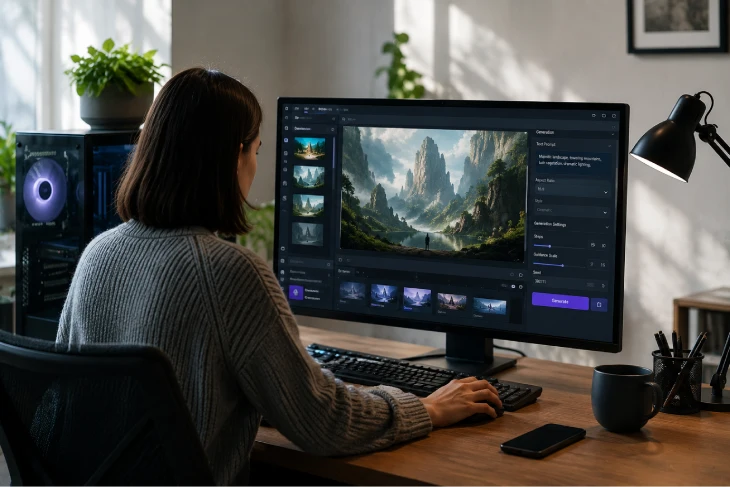
Image created with ChatGPT by OpenAI
It creates, rather than just sorts or predicts
Generative AI is a type of AI that can create new content, such as text, images, audio, video, or code, usually in response to a prompt. This sets it apart from many other AI systems, which are designed to rank, classify, detect, recommend, or predict rather than generate something new. Google Cloud's overview of generative AI offers a clear beginner-friendly explanation of that distinction.
People often use "AI" and "generative AI" as if they mean the same thing. They do not. Generative AI is one part of the wider AI field, not the whole field.
A simple way to think about it is this: some AI systems help decide what to show you, flag suspicious activity, detect patterns, or recommend the next step. Generative AI does something more visible. It produces a response, a summary, an image, a voice, a video, or a piece of code. IBM's explainer on generative AI is helpful here too, especially for understanding it as a branch of AI focused on producing original outputs from learned patterns.
Why it feels so different
Generative AI feels more direct than many older AI systems because people interact with it in plain language. You type a question, ask for a summary, describe an image, or request a rewrite, and it responds immediately with something that looks polished and usable. It feels less like software running in the background and more like a system you are actively working with.
That shift matters. Older AI systems often influenced people quietly, through rankings, recommendations, moderation, or automation. Generative AI is much more visible. It invites interaction. It gives people something they can read, watch, listen to, or edit. That makes it easier to use, but also easier to overtrust.
What it can actually generate
Generative AI is often associated with chatbots, but that is only one part of the picture. Today, depending on the system, it can generate:
- Text
- Summaries
- Images
- Audio
- Synthetic voices
- Video
- Code
The range is part of what makes this category so important. Generative AI is no longer just a writing tool. It is increasingly built into creative software, productivity tools, customer support, education platforms, search experiences, and workplace systems.
How it works, in simple terms
At a basic level, generative AI learns patterns from large amounts of training data and uses those patterns to generate likely outputs. A text model generates likely sequences of words or tokens. An image model generates visuals based on learned relationships between descriptions, styles, objects, and examples.
The result can feel original, and in some ways it is, because the system is producing a new output rather than copying and pasting one fixed source. But that does not mean it understands the material the way a human does. It works through learned statistical relationships, not judgment, lived experience, or true comprehension.
This is one reason generative AI can be impressive and unreliable at the same time. It can be fast, useful, and creative, while still producing mistakes, distortions, weak reasoning, or invented details.
Why people misunderstand it
One of the biggest reasons people misunderstand generative AI is that it often sounds or looks finished. A clean answer feels trustworthy. A beautiful image feels intentional. A smooth voice feels authoritative. But a convincing output is not automatically a correct one.
That matters even more now that generative systems are getting better at presentation. The more polished the output becomes, the easier it is to confuse fluency with truth, style with knowledge, and speed with reliability.
Why it matters in 2026
In 2026, generative AI is no longer just a novelty or a trend story. It is becoming part of everyday tools, creative workflows, learning environments, and workplace systems. It is also becoming harder to avoid, even for people who are not actively looking for it.
That makes a basic understanding of generative AI more important now than it was even a year ago. People do not need to become experts in model architecture. But they do need to know what kind of system they are using, what it is actually designed to do, and why "good output" and "true output" are not the same thing.
Generative AI now affects how people write, search, communicate, create, study, and make sense of information. A basic understanding of how it works, what it can do, and where it can go wrong matters much more than it did even recently.
What to remember when using it
The safest way to think about generative AI is not as a mind, a source of truth, or a replacement for judgment. It is a system that can generate useful content from learned patterns. Sometimes that content is excellent. Sometimes it is shallow, biased, or wrong. Its value depends heavily on the task, the quality of the prompt, the system behind it, and the human oversight around it.
One thing to remember: Generative AI can create convincing content, but convincing is not the same as correct.
In one sentence: Generative AI is a type of AI that generates new content, such as text, images, audio, video, or code, based on patterns learned from training data.
About The Author

Branislava Lovre
Branislava Lovre works with media organizations, CSOs, and institutions to implement ethical AI in practice, delivering hands-on training, strategic guidance, and keynote talks on responsible AI adoption.
Branislava Lovre
Branislava Lovre works with media organizations, CSOs, and institutions to implement ethical AI in practice, delivering hands-on training, strategic guidance, and keynote talks on responsible AI adoption.





Leave A Comment