

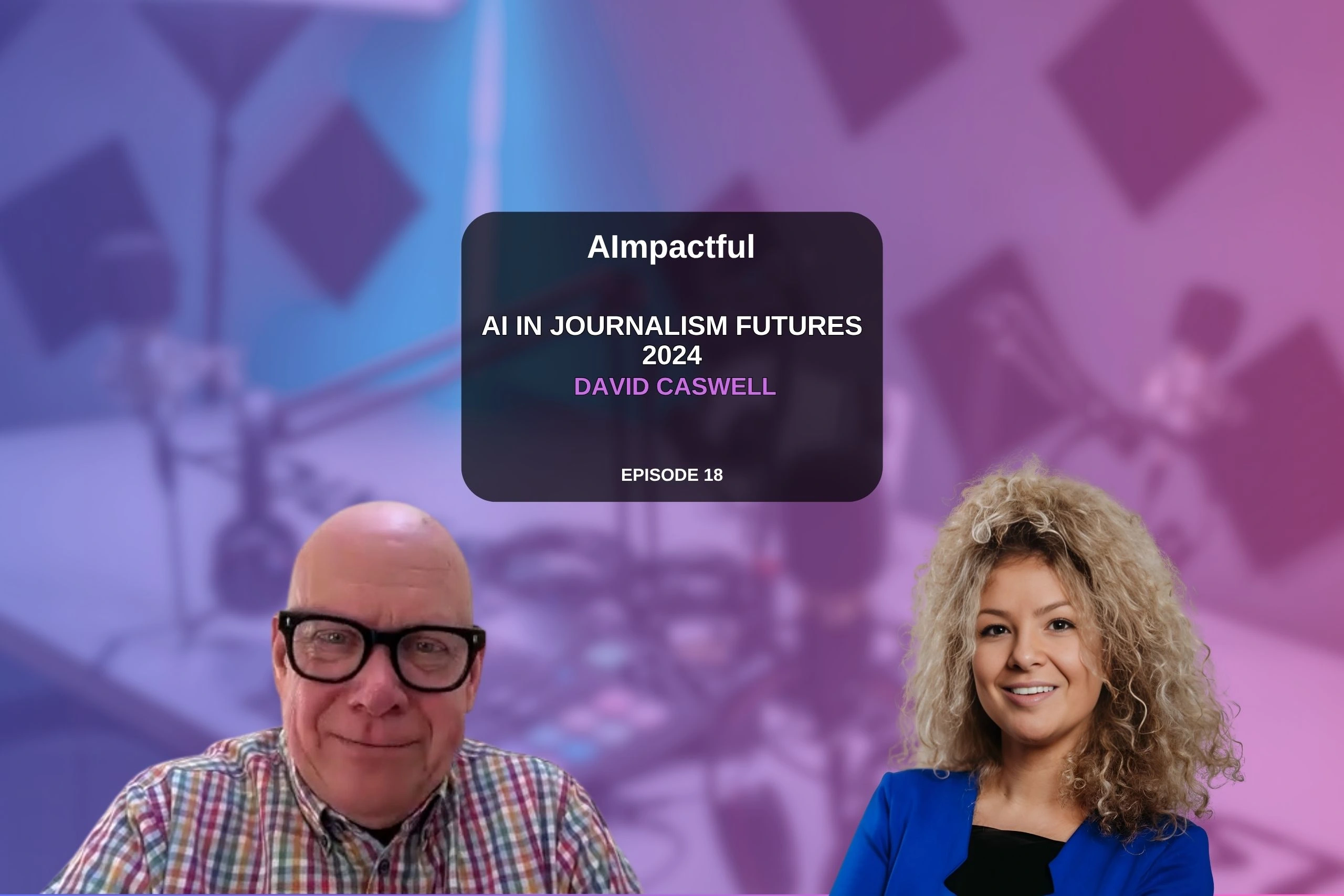
AI is here, transforming how stories are created, shared, and trusted. AI tools are drafting headlines, streamlining newsroom tasks, and shaping the way audiences interact with information. But while these tools are changing the now, the real question is: what happens next?
In this episode of AImpactful, we zoom out from today’s tools to explore how journalism itself could evolve over the next 5, 10, or even 15 years.
Today we’re joined by David Caswell, a pioneer at the intersection of AI and news. David is one of the most thoughtful and respected voices in this field, known for translating complex, technological shifts into practical strategies for newsrooms. He’s the founder of StoryFlow, and co-author of the report AI in Journalism Futures 2024, a landmark initiative that challenges us to imagine what’s coming, and to prepare for it with both clarity and care.
The AI in Journalism Futures project was no ordinary study. It brought together participants from across the globe, journalists, technologists, academics, and civil society actors, to consider what journalism could become in the age of AI. Through an open call for ideas, 40 future scenarios were selected and explored in-depth during a futures workshop in Piedmont, Italy, in April 2024.
From that process emerged five bold scenarios.
In our conversation, David walks us through:
- how these scenarios were created,
- what surprised the team most,
- and why scenario planning is an important tool for dealing with uncertainty,
He reflects on key insights from the project, including:
- a strong consensus that AI will profoundly reshape journalism and civic information,
- wide uncertainty about how this will unfold,
- and growing concerns that control over data and algorithms may concentrate too much power in too few hands.
What You’ll Learn:
- How scenario planning helps media organizations anticipate long-term risks and opportunities
- Why AI’s biggest impact may not be automation, but power shifts in the information ecosystem
- A breakdown of the five future scenarios, from “Machines in the Middle” to “AI on a Leash”
Who Should Tune In?
- Journalists and newsroom leaders thinking beyond short-term tools
- Media futurists and innovation teams
- Policymakers and regulators focused on AI and trust
- Curious citizens invested in the future of news
Episode Details:
- Duration: 22 minutes
- Guest: David Caswell, researcher, strategist, co-author of AI in Journalism Futures 2024
- Host: Branislava Lovre
- Format: Video podcast with full transcript
Transcript of the AImpactful Vodcast
Branislava Lovre: Welcome to AImpactful. Today we’re diving into the future of journalism not just what’s happening now, but what might happen in the next five, ten or even 15 years. We’ll explore the report AI in Journalism Futures 2024, a global effort to understand how it could reshape the way we share and receive information. This conversation is not just about technology. It’s about the future of trust, access to information, and the role journalism plays in our society. Today we are joined by David Caswell, someone who has deeply shaped how we think about the future of journalism in the age of AI. David is the founder of StoryFlow and the co-author of AI in Journalism Futures 2024, a report that challenges us to imagine what’s coming and to prepare for it with clarity and care. The report AI in Journalism Futures 2024 explores possible long term impacts of AI on journalism.
To start, could you explain what the scenario approach is and how you used it in the project? What method did you follow when creating the publication?
David Caswell: This is the AI in Journalism Futures Project and it’s a scenario development project. So there’s a technique for trying to understand what the possible scenarios are for uncertain futures. And this is a, it’s a well-established technique. Many large corporations use scenario planning. Many governments use scenario planning. Many militaries use scenario planning. And essentially what it tries to do is to systematically map out the range of plausible scenarios, without trying to predict which one is going to develop or what the, what the actual situation is. So it’s not a foresight or a a prediction or a forecasting exercise. It’s more about trying to understand what the range of things are. So this was a project that developed, it was funded and originated with the Open Society Foundation. And it was, it was based on this hypothesis which I think most people are in agreement with, which is that with AI in journalism, the initial work that’s going on in newsrooms right across the world and it is a lot of work that’s going on. Almost all of that is focused on making very familiar tasks and workflows and products more efficient. So it’s focused on the existing understanding of how the business works, how the competitive environment works, how the ecosystem, the information ecosystem as a whole works. And it assumes that all that’s going to remain the same, except that this little task here will be more efficient. Or we can produce these little products here that we’re already familiar with, like summaries or newsletters or whatever. And that period is well underway. Lots of newsrooms are doing that.
Branislava Lovre: What was the main hypothesis behind the whole project?
David Caswell: The functionality from AI is so fundamental to what news does. I mean, it deals with the heart of information that sooner or later it’s going to add up to something more than just making the existing way. We do journalism more efficiently. It’s going to add up to to a whole new, very different information ecosystem. So this is somewhat similar to how the introduction of smartphones with, beginning with the iPhone in 2007, that fundamentally changed how the information ecosystem worked. Social networks and the use of social networks to distribute news and so on and so on. And even further back, the, the Internet itself, moving from a purely print or a purely physical distribution environment to those early years of blogging and so on. But, this fundamental change in information was distributed that was caused by the Internet itself and then even further back, the printing press did, a similar fundamental change? Well, this hypothesis is that, the functionality from AI is going to add up to a fundamental change in the information ecosystem. It might be as small as mobile, it might be as large as the Internet, or even the printing press. But it’s going to be a significant change. So what we were trying to do with the scenario planning process is forget about the efficiency, forget about the sort of the near term, making the existing workflows more efficient and focus on, what might this add up to in the long term. And so we went through this in a very, very systematic way.
Branislava Lovre: The project started when you opened a call for people to send in their ideas about the future. You received more than 900 applications. What happened next? What was the following step?
David Caswell: We selected 40 of those that were particularly grounded and well-reasoned and thoughtful and insightful and creative. And then for those 40 people that submitted those, we asked them to develop their scenario a bit more. So to spend some more time thinking about it and developing it into a small kind of, four- or five-page description of it. And then we also brought in about 20 other experts in media, some of them, some very big names. And then we had this scenario planning workshop in Italy in April 2024, and that was a very formal, structured scenario planning workshop. It wasn’t just, one of these things where people just sort of like show up and have a chat. It wasn’t that at all. it was very formal, very systematic. It built on the preparation that these people had been doing for months before the workshop. So everybody came into the workshop, having been working on their scenario for months, basically. So everybody was very well prepared. And then it was a very structured a four part process. We went through guided by a professional facilitator of scenario planning, a person who does a lot of work for governments and large companies. And then we that delivered a lot of information. And then in May and June, we boiled that down into this report that describes the scenarios and and the process that produced them.
Branislava Lovre: How did you organize all the collected ideas? How did you sort them and put them into groups?
David Caswell: We ended up with five core scenarios. There was one that we called machines in the middle. And it’s essentially about a, an environment where large language models and AI is doing the reading, the, transcribing, natural language task or speech. It’s basically monitoring large chunks of the new of the sources of news. And it’s doing that systematically, continually. And so, one way to look at this, it’s like you have, tens of thousands of journalists that can just read every press release, listen to every speech, whatever they have read every report. And that’s on the newsgathering side. But then also on the production of the experience of news, . And right now, we see things like, summaries and emails produced by AI. But but it’s obvious that we’re going to have a lot more variety and personalized and customized experiences in audio and video and, and in all kinds of different forms of text, in different languages and so on. And so what machines in the middle, what that scenario is about, is the combination of both of those is, what, if you have an AI enabled newsroom and it’s using AI for a bunch of the news gathering and it’s using AI for a bunch of the creation of the experience, then, then that’s the machines in the middle scenario.
Branislava Lovre: Could you briefly present the second scenario that came out of this process?
David Caswell: We call this scenario, “Power flows to those who know your needs. ” And so it was a very, in some ways small p political view. Where that, the source of that knowledge becomes becomes exceptionally important. And there was two two aspects to that. One was as you would expect, would be data about users, but not just data in the way that we have newsroom analytics now, although that is obviously important. But new kinds of data that are possible only with AI. So very much more nuanced. Much more granular. Much more textured views of audiences and their needs and their behaviors. But you can now assembled out as data because you have machines that can observe and understand that. So the data was one. But then the second one, which I think is probably even more important, is the role of humans, of people who are essentially representatives of their audience. They know their audience very, very deeply, far more deeply than any machine is ever going to know the audience. They know their values. They know how they live their lives. They know what they talk about. They know what they laugh at. They know all of this stuff that you really have to be in the audience itself to know. And then they use that knowledge to bring this AI enabled information orchestra to produce something that is relevant to that audience. And so there’s a term that I increasingly use for this. I don’t think I use it in the report, but I call this listening as a service where the value that journalism delivers is more about the listening and respecting of the audience in a very deep way than it is about just broadcasting.
Branislava Lovre: There was also a scenario more focused on society about how different groups might use AI for information in very different ways. Could you explain that one?
David Caswell: The name we gave to this scenario was “Omniscience for me noise for you.” And that was like the represented the, in some ways the worst case but sort of the macro case for this, which is that some people will become they will develop superpowers because they can use AI to understand the world in far greater, depth and breadth than they ever could in any other way, because they’ve now got this, this set of tools, that enables them to digest. It’s like being, the president of the United States and having the whole CIA who’s just delivering a little briefing document to you every day. It’s that a, an enhancement of your ability to understand the world using AI. So that’s one group. But then you’ve got this other potential, which is that AI is used in ways that don’t enable agency or power in the individual. They’re used for things like entertainment or distraction or things that are very, very good, far better than say Tik Tok or YouTube are now because of these these AI tools, but don’t lead anywhere. They don’t provide information. They don’t provide education or growth or enable agency or power in the individual that’s consuming them. They just soak up their time. Right. And that was this sort of concern was that you would have this this bifurcated created or this this two-speed world, for one group of people, become much, much more, super powered with this and one with this other group becomes less so and that you can already see that happening with social media and digital media. But the the scenario was that this is amplified dramatically by AI.
Branislava Lovre: Then there was a scenario about restrictions, limits on the use of AI. What does that scenario describe?
David Caswell: There’s a lot of discussion about this. And some of that discussion was around regulation and kind of, legislation and government led restrictions. But most of it was not most of it was about other kinds of restrictions on AI, particularly a choices that audiences may make or some audiences may make, not to use AI. And so, there’s actually a lot of evidence for this in the existing ecosystem around like some forms of news avoidance, for example, or even more broadly in a an accelerating appreciation for non digital, forms of music and, other experiences is this rebellion against this flat digital world. And so that’s a very small part of the of societies now. But news avoidance is actually quite large in terms of its percentage of audiences. And it’s quite plausible that you could see, especially if AI is used in very untrustworthy or distracting ways, you could see large populations or large percentages of the audience basically opting out of AI. And there was a series of other non regulatory constraints as well that we explored. But in that scenario, AI even though it would be possible for it to operate much more broadly in the information ecosystem, in fact it actually doesn’t happen that way because, it’s not attractive to audiences for various reasons.
Branislava Lovre: And finally, there was the fifth scenario where AI gains some level of agency and power. What does that mean in practice and how is it that world imagined?
David Caswell: This was an extreme scenario. Our time horizon for this project was 5 to 15 years, and this would be more on the 15 year range. It’s not about, AI taking over the world, although, the way people are talking, who knows? Right. But it’s not about that. It’s about AI situation where, where humans, journalists, members of the public, everybody basically hand over willingly more and more control of the information ecosystem to AI. And we keep doing that. So maybe it’s easier to do some task in the newsroom and then it’s easier to do some other task. And then, well, we just hook up the newsgathering machine to the other machine and then, and then somebody leaves and some new person comes and they’re not really familiar with how all this is working. And slowly, over time, we lose the ability to understand how our information ecosystem is working. And then we get to a point where the the AI essentially or this kind of, ecosystem of AIs that are that are managing our information ecosystem. We don’t know what they’re doing. They have their own, essentially their own agency and their own power and their own sort of controls. And we don’t we can see they’re doing stuff and we’re consuming it, but we don’t know what’s going on inside. And there’s a big precedence for this. And the precedence is the financial system. You know, the financial system used to be relatively, centuries ago, relatively simple, understandable by many people. But there are very, very few people these days who understand, the financial systems, the global flows of capital and so on. And so that trajectory, you could you could quite easily imagine that trajectory happening with information flows if AI became a major part of it.
Branislava Lovre: When you gathered all these global perspectives, which scenarios or moments were the most surprising? Was there anything that really stood out during the project?
David Caswell: Each of those was surprising in its own way. More because it it was a way to distill or boil down, all of these different ideas and speculations from all of these people down into this this sort of course, there was another set of surprises that came from just observations or, insights from the process as a whole, that didn’t end up as scenarios, but were just sort of like standing back from from what was happening and having a look, one that was the most surprising of those for me and also for Shuwei Fang, my coauthor of the report and the manager for all of this from the Open Society Foundations. She’s the one, the driving force behind it. You know, her and I at the workshop basically came to this realization that much of the conversation and the developing scenarios were actually not about AI. They were about power. And that power and the transfer of power was this very significant thread in what was going through many people’s mind, especially journalists, especially people from an editorial perspective. And, we have a little less data on this or a sort of observational basis for this. But it seemed that people that were coming at this from the technical side, from the technology and were more focused on audiences and audience value, more focused on what you might see as a traditional product approach, which is, user centered, design thinking, all that stuff. Whereas on the editorial side, there was a not a lot of focus on power and power transmission, and that shows up in the names of some of our scenarios. You know, “Power flows to those who know your needs”, “AI with its own agency and power” and so on, power seems to be very front of mind in sort of the higher level of the discussion about this.
Branislava Lovre: And finally, what were the reactions from colleagues and the expert community after reading the publication?
David Caswell: One of the interesting reactions is, how many people have read it carefully. I’m surprised, that is interesting because it is quite a read and it is quite a dense read, but a lot of people seem to be reading it carefully. So that’s great. I think, the big one, is that people, which was one of our core objectives for the overall project, people are starting to think about what it all adds up to it. So it’s not necessarily that they look at the scenarios and say, oh, this is going to happen. I need to plan for this. That’s not what we were trying to do and that’s not what is happening. But they’re starting to think, well, there’s got to be more to this than my strategy of making, my newsletter more efficient or doing my SEO more efficiently, that this has to include, some view of the future. A lot of that at the moment ends up as discussions around our relationships with the model providers. And, I think that’s very appropriate at the moment. I think, sort of understanding the, how content is valued, how content is how it ends up in these models. And an experience is built from these models and, and how you, get paid for the production of content that’s difficult and expensive to produce. So, those are big questions that I think will take years to resolve. But I think that’s like a reasonable starting point. Another one that I see quite a bit is like senior teams in newsrooms are thinking more in terms of of creating flexibility to respond to uncertainty. So what what they’re taking from the report is, this this is an uncertain, the coming environment. You know, five, ten years down the road is very uncertain. We don’t we don’t know, what’s going to develop, but it’s likely to be significant. Therefore, we can make our organization, our organizational structure, our infrastructure, our CMS. We can make all that stuff more efficient or more flexible now so that whatever we have to do in the future, we’ll have more options to to respond to it.
Branislava Lovre: Thank you.
David Caswell: You’re very welcome. And thank you for the invitation.
Branislava Lovre: Thank you for watching this episode of AImpactful. Don’t forget to follow us and see you next time.

Leave A Comment