

Velora Cycling began as a small, practical test of a much bigger question in publishing: what changes when AI is built into the editorial workflow from day one? Behind the project are Peter Stuart, former editor of Cyclingnews, and Danny Bellion, former Head of AI at the fintech company Capital on Tap. Together, they launched a specialist cycling publication where AI helps monitor sources, rank potential stories, prepare research, support drafts, select images, add tags, create social media posts and check information. The editor still decides what gets published.
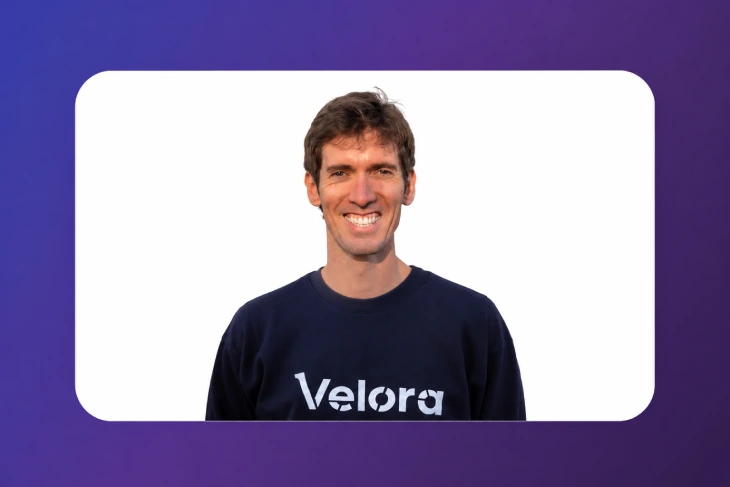
Peter Stuart
“There are three things I think we can’t even come close to competing with AI tools at. One is news discovery. One is an initial level of deep research on a topic. And another one is verification.“
“There are three things I think we can’t even come close to competing with AI tools at. One is news discovery. One is an initial level of deep research on a topic. And another one is verification.“
Reuters Institute highlighted Velora Cycling as an example of a “one-person newsroom” model, where AI manages parts of the operation that would previously have required a larger team, from drafting and image selection to tagging, social posts and fact-checking. The same report suggested that similar low-cost approaches could become more common in 2026, especially in specialist areas and local news.
Velora Cycling also served as the proof of concept for Velora. Stuart and Bellion used their own publication to build and test the system in real editorial conditions, then turned that work into an application other specialist publishers can use. In other words, the AI-supported routines tested on Velora Cycling are now available through Velora.
In conversation with Branislava Lovre for AImpactful, Stuart talks about what they built, why they focused on discovery, research and verification, and where automation proved weaker. His experiment with an AI agent running in parallel with him as editor led to a clear conclusion: AI can process a large number of signals, but it still does not understand well enough why one story matters now, for this particular audience.
Peter, thank you so much for joining AImpactful. Before we go into Velora and the technology behind it, I'd love to start with your own story. You spent years in cycling journalism and later became editor-in-chief of Cyclingnews. What did that experience teach you about the pressure inside digital newsrooms, and how did it lead you to build an AI-supported editorial platform?
My whole career has been spent in journalism and editorial work, originally as a features writer on general topics, and then moving more specifically into cycling content.
I started on a print-focused magazine, then moved into digital. I worked for an independent magazine where I led digital projects and expansion, and my last role before beginning this project was as editor-in-chief of Cyclingnews, which is the world's largest cycling editorial website.
That was a big, busy editorial environment. We had a team of around 13 to 15 people on the editorial staff, and sometimes 20 or 30 stories a day.
I really enjoyed my time at Cyclingnews and in my previous roles, but since the advent of AI and the development of AI technology, I've been fascinated by where this will take editorial and journalistic work, and the relationship between readers, content and news.
My co-founder Danny and I reconnected about nine months ago at a barbecue, after knowing each other through bike racing. We started talking casually about what the future of an editorial website would look like if AI was baked in at the start, structurally, not as an add-on.
After a few conversations, we both got very excited about the idea and decided to be quite reckless: we quit our jobs and went for it full time. Probably three or four weeks after we stopped working for our respective companies, we launched Velora Cycling.
What Velora is designed to do
Velora Cycling is a proof of concept for the wider Velora app. For people who are hearing about it for the first time, let's make Velora very concrete. If you were explaining it to an editor in a small or specialist newsroom, how would you describe what Velora does? Which parts of the editorial workflow does it support, and what kind of pressure is it designed to take off journalists and editors?
We break the overall picture of what a newsroom and publishing require into three basic elements: discovery, production and distribution.
Discovery is how you find stories that are interesting and important. Production is how you create content, format it correctly and put it into a CMS. Distribution is how you actually reach your audience. We have agentic processes in place for all three of those, as well as the SEO side of things.
The whole platform is fuelled by a large amount of inputs. One of the core drains on journalists' time is news discovery: spending a lot of time looking at what is going on across your sector.
For some people, that is a big part of what they do and they have the resources to do it. They can have Twitter open, Bluesky open, news feeds everywhere, and pick things up. But for a lot of teams, they don't have the ability to spend one or two hours in the morning going through hundreds of sources, hundreds of social accounts and lots of press releases in the inbox.
So the core tool looks very rapidly at potentially thousands of different sources and then uses editorial logic tied to the site to understand what has the highest engagement potential and what should be shown to the editor as a news lead.
Beyond news discovery, we use tools to offer the next level of journalistic input. The platform can look at a large amount of stories and what has been indexed, then suggest feature ideas, news follow-ups or story developments that other people have not covered.
Once a story is complete, you can also assess it for information gain. An AI tool looks at it and decides how original it is, how much value it brings to the broader competitive landscape, whether other titles have covered it, and whether the same information already exists elsewhere.
Can you walk us through the workflow as if we were inside a newsroom using Velora for the first time? Let's say a possible story appears. What happens from that first signal or news lead, through research, drafting and CMS preparation, all the way to the point where an editor can review it before publication?
The platform starts with a newsroom dashboard. It shows what is happening right now, traffic figures, newsroom leads, missed opportunities and feature pitches. Some of those are more analytical suggestions for in-depth coverage, while others are more functional SEO content or pitch-level ideas that an editor can take away and turn into an article.
The core part for a news title is the news pipeline. Discovery feeds come in through RSS, Google News, static web pages and, in our case, Companies House filings. For other clients, it could be different filings or financial information that can be scraped online to generate news leads.
Those inputs compile a large amount of international news in one place on a regular basis. The system assigns news a certain engagement score to tell us how important it may be to our audience. If something reaches the qualifying level, it is pushed through to the central news dashboard.
Websites are only one part of it. Emails are another part, so press inboxes can be assessed by the AI tool and given an engagement score. We also have social media sources: Twitter accounts, Instagram accounts and YouTube videos.
With YouTube, we do not only look at the video title. We look at the transcript and consider story leads from specific parts of the transcript. That has been very useful. At the end of a race, for example, there may be 10, 15 or 20 YouTube flash interviews, and our tool can look at all of them and understand the most interesting news lead from any part of one interview.
When those leads meet the threshold, or when they are manually pushed, they move into the news dashboard and the work can begin.
From there, an editor can decide to write manually inside the platform, using AI tools to help. The platform turns the research into a more in-depth research report, showing what happened, what the quotes are and where the sources come from.
If I start writing a news story manually, I can select the text and ask the AI tool to help me think about ways to improve it: where the gaps are, what angles are missing, how I can strengthen it, or whether something is factually true.
Those are the same questions I used to ask when writing with ChatGPT or Claude as a co-writer, but we integrated them into the platform as an innate tool that writers can use.
For some content, you can also use an AI drafting tool to reach a full draft more rapidly, which the editor can then pick up and edit.
The important part is auditability. You can see the research, the point at which the editor decided a draft should exist, the draft that AI made, and the editor's draft that eventually goes into the CMS and can be published.
The AI writer only writes from the research that has already been compiled. It does not try to write new content. So the editor has clear visibility over what forms the story and what the writer is using.
After that, production processes move the story towards CMS level. The article can be populated in the CMS with a title, slug, excerpt, properly attributed links, author details, SEO details, tags and taxonomy.
The platform can also choose an image from the available image collection and generate useful alt text. But everything remains in draft state. This is not something that automatically publishes for you. The journalist still has to make the final call.
In short, Velora's workflow looks like this: news signal → AI-assisted discovery → research report → editorial decision → manual writing or AI-supported draft → verification → originality check → CMS draft → human editorial sign-off.
You mentioned discovery, research and verification as some of the core parts of the workflow. Why did you decide to focus so strongly on those parts of the process, and where do you think AI can help?
There are three things I think we can't even come close to competing with AI tools at. One is news discovery. One is an initial level of deep research on a topic. And another one is verification.
At this point, those three elements of the workflow can be done exceptionally well and very quickly by AI tools. So those are three parts of our pipeline that we focused on, and we believe they are exceptionally good at what they do.
Each one of them has been customized specifically by us to suit the needs of journalists, rather than just being a normal AI tool asked to do something from a cold prompt in a chatbot.
Custom deep research has been the most useful tool for us. It gives a very well articulated overview of a topic that may have come in as a news discovery lead. It breaks down the sources that have covered that topic, gives clear citations for comments, quotes or information, and gives us an audit trail.
That means that when we are working on an article, we can look back and ask: where did this quote originate from? Did we properly credit it? Was it properly checked?
The difficulty with normal consumer deep research tools is that they are often customized for very different use cases. They may be used for academic work or company research. They do not necessarily favour the recency and immediacy you need in journalism.
Our tool focuses very much on what has been said today, what has been said in the last few weeks, whether information is fresh and whether it is out of date. That took a lot of fine-tuning, but we think we have reached the point where it works very well in the pipeline.
Reveal Quote
“The real question is not whether someone relied on an AI tool, but whether the output adds value. Is it a valuable piece of content? Does it have good insight? Is it useful? Is it interesting?”
Reveal Quote
“AI has a place in every sort of publishing setup in 2026. But I think it has a particular role in smaller publishers, where it can take a large amount of workflow off editors’ plates.”
Verification, originality and trust
One of the biggest concerns around AI in journalism is trust. A tool can help a newsroom move faster, but speed is not enough if the process is not transparent. How does Velora handle verification, originality and the question of whether a story actually adds value compared with what is already online?
We have an internal verification that checks the work of the writer in draft form to ensure that the draft has not introduced errors. Beyond that, we also have deep verification.
Deep verification is an in-depth check of all the content in the initial draft. Whether it is a draft you wrote yourself or a draft created with an AI tool, deep verification checks every claim against grounded search to ensure that it exists and is relevant to a credible source.
The deep verification report shows exactly where the source has come from. You still have the research to refer back to, so the whole thing gives you a clean trail.
We also have a test of originality that determines how strong an article is in comparison with what exists elsewhere on the internet. It can show whether an article adds enough information gain. If the score is low, that is a signal to hold the piece and not publish it unless we can add more value and originality.
For publishers, there are also very practical questions. How does Velora connect with existing CMS systems, and how do you protect client data inside an AI-supported workflow?
So far, we have only encountered the CMS systems our clients use, and they are largely WordPress. Sanity is our CMS, and Webflow is an integration we have used for another client.
Whenever there is API access to a CMS, we can use the Velora platform with it.
On privacy, I would say we are belt and braces. My co-founder comes from fintech, and we have a very robust database system that is very secure. The AI models we use do not train on customer data, we have Row-level security on our stored data and customers can request their data is deleted.
All client information remains entirely confidential and is owned by them. With new AI projects, there can be a risk that things are stored in a spreadsheet somewhere, but we have a robust data storage, privacy and confidentiality structure in place.
We probably have the infrastructure for SOC 2 compliance, but we have not gone for it yet because it is an extra expense and no client has requested it. But we have the means to achieve that if needed.
I'd like to touch on the technical side as well. Was Velora built completely from scratch, or is it a custom system that works with existing AI models and tools such as Claude?
The technical side is really Danny's domain. He is the architect of it, so my answers are from the journalist's perspective rather than from a highly technical one.
Effectively, our entire system is a custom code base that relies on certain LLM tools that it calls out to. Last time I checked, we had 13 different types of models employed in the pipeline.
Our code base is constantly reviewed, both in terms of the code itself and the LLM tools. When a new model comes out, we evaluate it against the previous model to see if it does the job better.
The front end is also designed by us. The thing that is third party is the AI tools that do the heavy lifting. But there is no avoiding that, because the frontier AI tools are the best you can get.
If someone at The New York Times has an exceptionally clever AI tool for news discovery, they are probably using the same actual frontier model that we are using in our pipeline. For these use cases, it is not expensive in terms of individual AI API costs.
We built the code, and we relied on AI tools to help us build quickly. Claude Code is now used across everything we do to support our development work.
We also have an MCP that connects to the Velora app. That is useful because the screens inside the app are logged and accessible to the MCP. This gives you the ability to interact with everything that has been surfaced on Velora, or created within it, using a chatbot interface.
That means you can use a chatbot like Claude to interact with Velora, which is useful for more advanced users. It offers a level of auditability and step-by-step analysis that is very hard to do with a manual workflow.
Some parts are much more complex and proprietary. The news discovery tool is a bespoke solution. It requires embedding into a database of all the sources that have been logged. The deep research is also an entirely customized pipeline, using multiple AI calls to generate the research report.
It is not just asking Gemini or ChatGPT to do deep research. It is a customized solution, because without that, it is very challenging to build something usable for journalists in a robust way.
Authorship, ownership and accountability
Let's move to the ethical and editorial side, because this is where many conversations about AI in journalism become complicated. In a workflow where Velora can support research, drafting, verification and CMS preparation, where do you draw the line between assistance and authorship?
Anyone who uses the Velora platform has their own editorial policy. That is their editorial policy, and that is the important thing I would always come back to.
We designed a pipeline that is able to do everything. The fact that it can draft articles is not unique to us. People can do that with any commercially available tool. But in many cases, it is relevant and useful to have that automation.
We wanted to create it so that if you use automated drafting, you can do it in a way that has a trail, auditability and accountability. A journalist is clearly present at the right points, making the right decisions, and you can see the attribution.
In terms of authorship, I think that is a complex question. My personal view is that if you have decided that a draft should exist, created the draft, edited it, are happy with it and feel that you have appropriately fact-checked it, then authorship is relevant and appropriate.
Some people would say that you might not have done all the work for it. But I think authorship has already changed so much in terms of what writing means that I do not think the labour of writing is the key thing that determines whether someone should say they are the author of a piece of content.
The real question is not whether someone relied on an AI tool, but whether the output adds value. Is it a valuable piece of content? Does it have good insight? Is it useful? Is it interesting?
AI tools are now so embedded into the systems we use that it is almost impossible to say a piece of work has had no augmentation at all. If it has used transcription tools, or Grammarly, or sub-editing assistance, AI tools and LLMs are already playing a part in the process.
For me, if you are willing to take ownership of every single word, and if it is wrong you bear the responsibility, then you can claim authorship. But it is a double-edged sword. You can take credit for the work, but you also bear total responsibility if anything is incorrect.
That is what is really important in this discussion. It is about accountability, not simply who wrote the work.
You already have early users and clients, which is always the real test for any newsroom technology. What kind of feedback have you received so far?
On the whole, our clients have been really happy with the tools. We began with people approaching us on LinkedIn and asking to use the tech, and everyone who did that stayed with us as a customer.
Then we had friends in the publishing space test the technology, and they often came on board too.
When people are fully set up on it, it becomes part of their infrastructure and they see a large time gain. That is the main thing we have seen across the board.
One client was able to spend two or three hours less on press release and production work, and then invested that time in finding more interviews and original insights. They also spent more money on freelance content that could do original work, because they felt they could cover more commodity news more quickly using our pipeline.
Other clients have found news discovery very useful because they were able to find stories others were not able to find.
The only place where we find tension is the initial setup phase. A client has to come on board and populate their news leads. The AI can do a lot to understand their site, but the client has to define many of the sources that matter to them.
If people do not understand how to populate that set of inputs and the news discovery pipeline, they do not get as much value. We are trying to make that easier, but we also want people to decide their own sources and where they get information from.
Our AI tool could populate everything, but we think sources are part of the brand for each client.
One person saw output increase and more than 100 percent growth in overall news traffic. Another said they got about two hours back a day from using it. Those are the main signs for us that we are doing something useful for journalists and time-stretched publishers.
One last practical question, especially for publishers outside the English-speaking market: which languages does Velora currently support? Is the platform mainly designed for English-language publishing, or can it also work for European and multilingual newsrooms?
It is multi-language. We have not found a language we cannot do yet.
We have mostly tried European languages, but every European language has been totally functional in the app. We do Dutch, French and German content, and it has all worked really well.
Generally, languages that frontier models are able to handle are exceptionally good in the app. One of our biggest clients is Dutch-speaking.
Can newsrooms opt out of AI?
We hear more and more that journalism will increasingly depend on agentic AI systems, and that without them it may become difficult for small, and even large, newsrooms to remain competitive in the media ecosystem. At the same time, some journalists argue that our role is still to produce high-quality journalism for people, and that newsrooms can remain visible and valuable without relying heavily on AI. How do you see this tension, especially when we consider money, resources, audience attention and competition?
There are absolutely titles that can exist with entirely manually written content and do not need to have AI tools at all if they do not want to.
If you have a very affluent newsroom, a high subscription base and a very high-revenue title, your readers may expect something more like artisan writing, where the author has taken a long time creating a piece of work.
You see that with titles like the Financial Times or the Sunday Times, where a piece of work may take a writer two, three or four days to create. That is not uncommon.
But there is another side of journalism where people may have to create five to 10 articles a day. That is not something AI created. That has been the case for decades in digital newsrooms.
For artisan content, I would still say that AI can do some things better than you can do without influencing your creative process. News discovery, challenging your work and verification can be very effective without encroaching on your ability to say that the creative output is human.
For high-volume newsrooms, or any newsroom that has an expectation of producing news alongside features and original insights, I think AI will need to play a role in most businesses in the future, especially small teams. That is where the competitive landscape has gone.
When I was at Cyclingnews, I saw competitors using probably quite rudimentary ChatGPT workflows to make lots of content very quickly. At first I thought, this is totally unacceptable. But the more I looked at it, I realized that although I did not like the language or the process, the content was kind of the same. They had taken something that happened and very quickly created content from it.
In small sectors, that is already happening. Some titles have been able to create scale and output quickly at very low cost. If you are still using a workflow that requires a huge amount of manual work in areas where you are not offering much information gain or insight, that is structurally problematic, because you are operating at a much higher cost than your competitors.
My view is that AI has a place in every sort of publishing setup in 2026. But I think it has a particular role in smaller publishers, where it can take a large amount of workflow off editors' plates.
It may also be useful for lower-lift press release content or commodity news, where human oversight is still required, but a lot of writing and articulation may not be necessary in the same way it is for more complex work.
And when we talk specifically about agentic AI, there is often an assumption that agents will eventually act almost like autonomous journalists or editors. You tested an AI agent against yourself as an editor. What did that experiment reveal about the limits of automation when the task is not just producing text, but understanding relevance, context and editorial priorities?
My view is that the technology is not there to do that yet. I do not think, as things stand, you can have a tool that simply does everything by itself.
Maybe there are some sectors where that might work, with very specialist, controlled data in predictable ways. Weather or purely financial report-type content may be examples where programmatic content works well.
But in a more complex specialist area, I still think you always need a person making the key editorial decisions.
We actually ran a parallel experiment for Velora Cycling where there was an agent running against me as the editor. I am happy to say that it could not really do anything. The content it focused on didn't really work in a practical or cohesive way for our audience. The editorial choices it made didn't make sense to us.
The editor and the journalistic role can be emotionally leveraged and complex in a way that tools do not really understand. That is even before you get to accountability.
I think the word "agentic" can be intimidating. People hear it and imagine a crazy, complex, advanced technical solution. But most of the time, agentic flows are controlled tasks that you give to an AI tool.
A verification tool, for example, can be quite simple and still add a lot of value.
Where it becomes harder is when an agent has to make several independent, autonomous steps that lead to an outcome. That can be very good for coding, but I am not sure there is much scope to do that in editorial in the true agent sense.
Our image selector is an agent in that sense, because it has to make independent autonomous choices about which image to select. But beyond that, we have an agentic flow that is very structured. It is not lots of AIs acting autonomously, because that would be technically hard and very unpredictable.
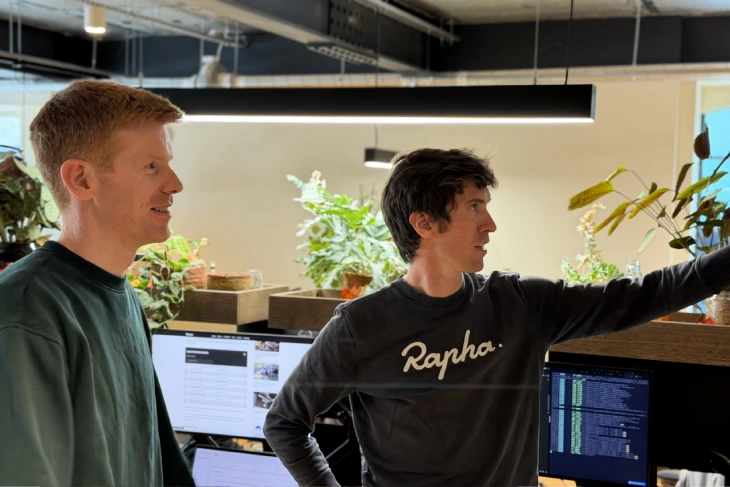
Peter StuartPeter Stuart and Danny Bellion, co-founders of Velora.
(Image from Peter Stuart’s private archive.)
Advice for journalists and editors starting with AI
Many journalists and editors are curious about AI, but also overwhelmed. They hear about agents, APIs, tokens, custom tools, privacy risks and new platforms, and it can feel like too much, especially for small independent teams. What would be your practical advice for a newsroom that wants to start improving its workflow with AI without wasting money, chasing hype or losing control of its editorial process?
One of my most passionate pieces of advice is that, historically, journalists have largely been a non-technical breed. Most journalists are not highly technical and are not really engaged with the tech and software side.
But AI has removed a lot of that barrier, and many people do not realize it. You can really build something. You can build more or less whatever you want. It might not work very well, but you can build something with AI tools.
If you have an idea that you want to aggregate something, or collect Companies House filings and turn them into news leads, you can probably start building it yourself with Claude Code on a £20-a-month plan and get quite far.
In journalism and publishing, it is really important that the superuser plays a key role in developing the technology they use.
Things break down if you have a tech team over here developing a solution for journalists or publishers over there, because the disconnect is so strong.
Technical people often do not expect the pinch points and tension points that journalists encounter. Those can be surprising to them.
So building as a superuser matters. You can ask: what are my pressure points, and how do I build around that?
You also do not always need to build from scratch. There are many people on LinkedIn who share GitHub repositories from major publishers and open-source technologies they have launched.
For example, The Guardian has an open-source tool on GitHub for turning a news story into social media content. We did not use theirs, but it is an example of how a technical problem you have may already have been solved by a major publisher and made free to use.
The open-source journalism landscape is richer than many people realize. There is a lot of software and many solutions that are completely free to use.
My last point is that a lot of people think AI has run away from them or that it is only for tech people. But AI is very accessible. It is probably one of the most advanced technologies that has ever existed, and almost anyone can load it up for free as a starting point.
If you used AI a year ago, things have changed. The technology today is very impressive. Now is a good time to key in again if you have not done so before, and to understand what AI is capable of doing and what you can do with it.
Before we finish, is there anything you would like to add for editors, journalists or publishers who are rethinking their workflows, or for people who would like to learn more about Velora?
Our website is velora.build, and I'm Peter Stuart on LinkedIn. We are a small team and early in our journey, so we are really keen to work with people.
If you look at the product and think about how this could be used, but would like different features, we are still very open to developing and changing the platform for clients.
We are also open to feedback. We are not at the point where we have a waiting list or anything like that. We are very happy to have people come on the journey with us.
If this sounds interesting, get in touch. And even if you just want to chat and exchange knowledge, I'm happy to have a virtual coffee.
About The Author

Branislava Lovre
Branislava Lovre works with media organizations, CSOs, and institutions to implement ethical AI in practice, delivering hands-on training, strategic guidance, and keynote talks on responsible AI adoption.
Branislava Lovre
Branislava Lovre works with media organizations, CSOs, and institutions to implement ethical AI in practice, delivering hands-on training, strategic guidance, and keynote talks on responsible AI adoption.





Leave A Comment